In term two we learnt about the Treaty of Waitangi and we investigated New Zealand history. This prepared us for our school camp to Russell and the Waitangi Treaty Grounds. We took some footage of the places that we visited and we used these images and videos as the background of our film festival movie. We wanted to create a movie that would teach other students about the treaty; to share our learning with them.
Thanks to Bensound (2017) for providing the Royalty Free Music that was used in this movie.
We hope you enjoyed our movie and that you learnt more about the Treaty of Waitangi!
We are a Year 6 / 7 class at Glenbrae school. This year we are exploring the topic of sustainability. Check out how we learn, create, share in room 8!
Showing posts with label Te Reo. Show all posts
Showing posts with label Te Reo. Show all posts
Wednesday, 8 November 2017

Wednesday, 18 October 2017
Te Reo Bingo!
This week in te reo Maori we learnt the name for some of our favourite food and some common foods in te reo Maori. This was to support our current learning which is focused on food and drink.
We will continue to focus on this for the first part of the term, so keep a look out for some of the flash cards that we will be creating!

We will continue to focus on this for the first part of the term, so keep a look out for some of the flash cards that we will be creating!

Sunday, 17 September 2017
Te Wiki o Te Reo Maori
In honour of te wiki o te reo maori, we took part in a breakout all about te reo maori. We split up into groups of four and practiced team work, problem solving and using te reo maori.

Our groups found the first few clues quite quickly. They involved colours (which we learnt in term 2) and numbers (which we discussed this week when we practiced telling eachother how old we are). After some time, three groups got stuck on the same lock. Miss Stone gave them all the same hints, but even then it was quite tricky to work the whole clue out!

In the end Alex, Dekorah, Maselino and Trents group won the Breakout, although it was very very close!

Our groups found the first few clues quite quickly. They involved colours (which we learnt in term 2) and numbers (which we discussed this week when we practiced telling eachother how old we are). After some time, three groups got stuck on the same lock. Miss Stone gave them all the same hints, but even then it was quite tricky to work the whole clue out!

In the end Alex, Dekorah, Maselino and Trents group won the Breakout, although it was very very close!
Thursday, 24 August 2017
Waitangi Treaty Grounds
On Thursday morning we returned to the Treaty Grounds with Sarah from Adventure for Good. We met with Whaea Roy and Whaea Monica who we had met during the Powhiri on Monday.
The treaty grounds were a great place for us to consolidate our knowledge about the Treaty of Waitangi. It was great to see one of the copies of the Treaty with some of the signatures on it and to discuss the main events of the time. Here are some of the facts that we found most interesting:


The treaty grounds were a great place for us to consolidate our knowledge about the Treaty of Waitangi. It was great to see one of the copies of the Treaty with some of the signatures on it and to discuss the main events of the time. Here are some of the facts that we found most interesting:
- There was a fear that the French would invade New Zealand. A French man named Charles Philippe Hippolyte de Thierry tried to create a French Colony in 1837 which he planned to lead, but he was unsuccessful. In fact, there were a few attempts by the French to colonize New Zealand, but the Treaty of New Zealand was signed swiftly after these attempts were made, stopping the French plan from being carried out. We had talked a little about this in class but we did not know that the French were this active in attempting to colonize New Zealand.

- In 1835 Māori rangatira or chiefs signed He Whakaputanga - Declaration of Independence to stop people from other countries from making laws in New Zealand. This was the first time that different iwi had stood as one people and it established Te Whakaminenga, the Confederation of United Tribes. The British supported this document and King William IV was dubbed the protector of this. James Busby facillitated the creation of this document and he believed that it would stop other countries from making formal deals with Māori.

We also discussed the differences between the two versions of the Treaty and the way that the Treaty was signed (including the fact that it did not make it around all of New Zealand/ every rangatira).
We then travelled to the Wharenui on the Marae where we looked at the different carvings and patterns. The students got to draw their own Tukutuku panels which was a lot of fun! After creating our artworks we stopped to have a quick game with Ti Rakau and some kai before travelling down to the water to see a waka.

Whaea Roy told us about the waka and how it sails every year for Waitangi day. She also told us the story of when her dad got to row in the waka in the 1970s as part of a display for Queen Elizabeth II.
 |
| Sitting on the stump of one of the Kauri trees that was used to build the waka |

We then hopped back in the bus and travelled up the road to Paihia Town where we looked around the pier, shops and brought some kai for our lunch.


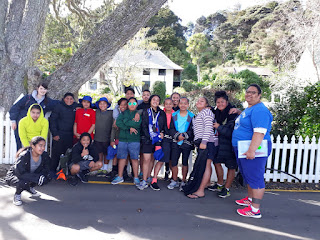
Finally we enjoyed a picnic at the Waitangi Reserve alongside Michael and Sarah from Adventure for Good and all of our Glenbrae School Whanau.
Wednesday, 23 August 2017
Our Trip to Kerikeri
This afternoon we headed to Kerikeri to learn more about the history of the area and the relationship between the Maori and the settlers. We got to travel over in the car ferry which was a lot of fun and felt quite strange as the boat was moving but the car stayed still!

Once we arrived in Kerikeri we drove up towards Kemp House and the Stone Store with Sarah from Adventure for Good.

We first headed to Kemp House (which is New Zealands oldest building) for a tour. In 1814, Nga Puhi chief Hongi Hika sailed to Sydney with traders on a ship called The Active. In Sydney he met Samuel Marsden, who he invited back to the Bay of Islands. With Hongi Hika's protection, Samuel Marsden began to build in the area as he wanted to create a Mission station in the Bay of Islands to spread Christianity around New Zealand. In 1818 Samuel Marsden brought 13,000 acres of land form Hongi Hika and he instructed Reverend John Butler to build the mission house (later known as Kemp House) in 1822.

The house then had several different owners, but it was occupied by the Kemp family and their descendants from 1832 to 1976 (142 years) until it was donated to Heritage New Zealand. The house is styled to appear as it did in 1832 and some of Charlotte Kemps original furnishings are still on display today.

After this tour we visited the nearby Stone Store. This was originally built in 1832 as a shop for the missionaries, where kai from the local farms were sold. Over the years it has been used as a library, military barracks and a boys school, before it was used once again as a general store from 1874, run by the Kemp family. It is now set up as a museum and it has lots of information about life in the 1800s inside.

Finally we visited Rewas village, where our guide Kepa told us a lot more about Hongi Heke and the Ngāpuhi iwi who occupied the area. Just beyond Kemp House once lay Kororipo Pā and a large Kainga (village). Kepa told us about some of the famous Rangatira (chiefs) who had lived in the area including Hongi Heke and Tāreha of Ngāti Rēhia who stood at over seven feet tall.

He then showed us around the replica fishing village, which gave us an idea of what Māori life was like before the Europeans arrived. We looked at different types of Rongoa (herbal medicine) and kai that the Māori used at the time and still use to this day. It was fabulous to see how to pick and use this Rongoa, as our local supermarkets sell pricey versions of these natural remedies which are not too difficult to find!

Tuesday, 22 August 2017
Historical Russell
This morning Mrs Tofas group, Miss Stones group and Michael from Adventure for Good headed to Russell town to explore some of the museums and historical sites there. We were looking forward to learning about what the area was like around the time the Treaty of Waitangi was signed. At this time, the capital of New Zealand was in the Bay of Islands, so this was were most of the trade was carried out and where a lot of Europeans headed.

We first stopped off at Christ Church or Te Whare Karakia o Kororareka which is New Zealand's oldest church! The church was built in 1835 by some of the early missionaries (European priests and Christians who wanted to teach the Maori about Christianity). It's first service was held in 1836 and the priests spoke both Te Reo and English. It was visited by lots of Maori and Europeans, including William Hobson and it is the Burial place of Ngāpuhi chief Tamati Waka Nene.
The church is still open and in use to this day and it was been visited by thousands of tourists and public figures over the years, including Queen Elizabeth II, Prince Philip and then Prime Minister David Lange
 .
.
After this we headed to Pompallier Mission. In 1839, French Catholic Bishop Pompallier bought land in Russell with the intention of building a print works that would create Catholic prayer books in Te Reo Maori. He was the first Catholic missionary to do this and had a difficult job in front of him, as there was a lot of Protestant Missionaries in the area who had already converted Maori and who attended Christ Church. In 1842 the building was operational and they created over 30,000 books until 1850 when the mission left Russell.


Inside Pompallier Mission we were taken on a tour of the building where we were shown how the books were created, from the leather hides that bound the books to the way the words were printed on the paper.
 We then headed over to Flagstaff Hill where we visited the flag pole that Hone Heke chopped down three times to protest the Government moving the capital city from Okiato to Auckland. The view up here was stunning and rife with natural wildlife.

To conclude the trip we took a quick look around Russell Museum before we headed back to base camp for some kai.


We first stopped off at Christ Church or Te Whare Karakia o Kororareka which is New Zealand's oldest church! The church was built in 1835 by some of the early missionaries (European priests and Christians who wanted to teach the Maori about Christianity). It's first service was held in 1836 and the priests spoke both Te Reo and English. It was visited by lots of Maori and Europeans, including William Hobson and it is the Burial place of Ngāpuhi chief Tamati Waka Nene.
The church is still open and in use to this day and it was been visited by thousands of tourists and public figures over the years, including Queen Elizabeth II, Prince Philip and then Prime Minister David Lange

After this we headed to Pompallier Mission. In 1839, French Catholic Bishop Pompallier bought land in Russell with the intention of building a print works that would create Catholic prayer books in Te Reo Maori. He was the first Catholic missionary to do this and had a difficult job in front of him, as there was a lot of Protestant Missionaries in the area who had already converted Maori and who attended Christ Church. In 1842 the building was operational and they created over 30,000 books until 1850 when the mission left Russell.


Inside Pompallier Mission we were taken on a tour of the building where we were shown how the books were created, from the leather hides that bound the books to the way the words were printed on the paper.


To conclude the trip we took a quick look around Russell Museum before we headed back to base camp for some kai.

Monday, 21 August 2017
Setting off for Camp!
This morning the year seven and eight students at Glenbrae School assembled in the hall as we prepared to set off for camp. The room was abuzz of excitement, filled with baggage, students and family members who were both anxious and excited to see their tamariki set off for five days.

We said a karakia as a group before we boarded the bus and waved goodbye to our whanau and class mates. The year six students of room 8 said farewell before they made their way to different classes around the school, where they would spend their week learning and mentoring the younger students.
Our first stop on our long journey was to Ruapekapeka Pa, a defense that had been used in the land wars. We had read about the land wars as a class and we recognized that this was the site of the northern war in 1845, a war between Ngāpuhi, Hone Heke and the British. While the Pa was strong, the British greatly outnumbered the Maori and were eventually successful at taking over the land.
We then returned to the bus and headed to the Waitangi Treaty Grounds. Here we were welcomed with a Powhiri and tour of the museum.


We also met our Adventure for Good Camp Guides here and played a few sports games with them to introduce ourselves.
 We then all traveled to Russell on the ferry for fish and chips on the beach before we arrived at our base camp (Orongo Bay holiday park) and settled in for the night.


We said a karakia as a group before we boarded the bus and waved goodbye to our whanau and class mates. The year six students of room 8 said farewell before they made their way to different classes around the school, where they would spend their week learning and mentoring the younger students.
Our first stop on our long journey was to Ruapekapeka Pa, a defense that had been used in the land wars. We had read about the land wars as a class and we recognized that this was the site of the northern war in 1845, a war between Ngāpuhi, Hone Heke and the British. While the Pa was strong, the British greatly outnumbered the Maori and were eventually successful at taking over the land.


We then returned to the bus and headed to the Waitangi Treaty Grounds. Here we were welcomed with a Powhiri and tour of the museum.

We also met our Adventure for Good Camp Guides here and played a few sports games with them to introduce ourselves.

Wednesday, 9 August 2017
Te Reo
This week in our te reo lesson we learnt how to ask someone for a drink. Check out the cartoon that Alex and Trent made below:
Friday, 4 August 2017
Te Tiriti o Waitangi
This week in writing we created an explanation about the Treaty of Waitangi. The students then had to present their writing in a DLO that would teach others about the subject. Some of the students created Explainer videos which you can watch below!
Anita, Salote & Tumanako
Davarni & Telesia
Anita, Salote & Tumanako
Wednesday, 2 August 2017
The New Zealand Wars

Thursday, 8 June 2017
Colours!
This morning we were learning our colours in te reo Maori. Check out the way Telesia has described the following items:
Tuesday, 21 March 2017
The Marae!
Today in our reo lesson, room 8 looked at the different parts of a marae. We started with an activity and game labeling the different parts of a marae and then we got the chromebooks out and labelled an image of Waiwhetu Marae.
Check out Anita's image below

Check out Anita's image below
Subscribe to:
Posts (Atom)